From royal courts to the present day
Jewellery made from butterfly wings is not just a current fashion trend. Its history is a fascinating story of admiration for nature, technological advancement, and the desire to capture fleeting beauty for eternity.
Victorian fascination
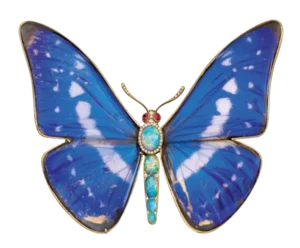
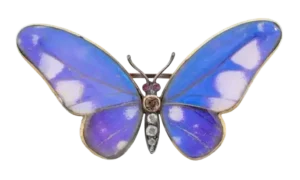
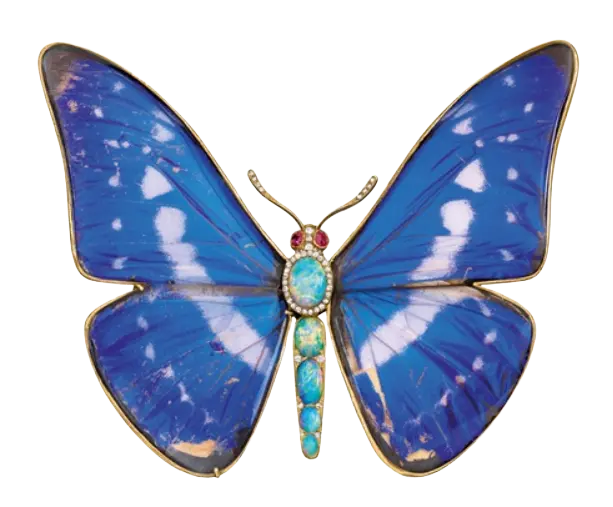
It all began in the 19th century. The Victorian era was obsessed with natural history. Collectors and jewellers searched for ways to preserve the vibrant colours of tropical butterflies, brought to Europe by sailors from exotic journeys. The first jewellery took the form of precious gold lockets, in which wings were set under glass like gemstones. These were unique pieces that symbolised transformation and the fragility of life. It wasn't uncommon to see whole butterfly bodies, or other insects (even beetles with metallic wing casings), in brooches. Victorian jewellery mostly consisted of unique handmade gold pieces, often adorned with small pearls or precious stones.
Art Nouveau / Secession
Art Nouveau (c. 1890 – 1910) loved nature-inspired lines, and the butterfly was its central symbol of transformation and the soul. Artists such as René Lalique although butterfly motifs were made more famous by enamel (technique plique-à-jour), but a Viennese jeweller Ernst Paltscho As early as 1906, he experimented with inserting real wings directly into complex floral motifs. During this era, research began into how to preserve the colour of the wings. The first attempts at hermetically sealing wings between two panes of glass appeared around this time.
Exotic souvenirs
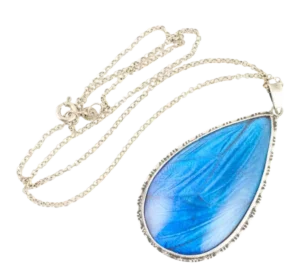
In the late 19th century, jewellery made with the wings of Morpho butterflies was produced directly in Brazil. Sailors and travellers brought them to Europe as exotic curiosities. They took the form of rather simple silver frames, in which entire wings, unpainted, were set to highlight their natural blue colour. It was these souvenirs that later inspired British manufacturers to mass-produce them.
The Golden Age: The Art Deco Era
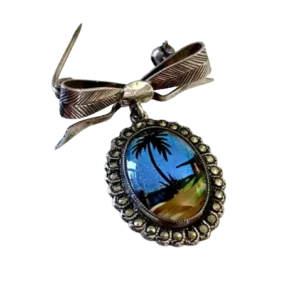
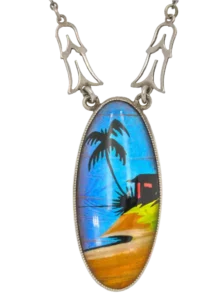
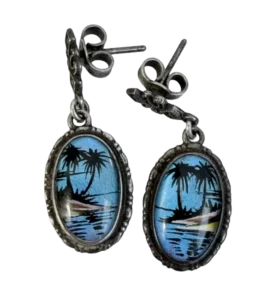
The 1920s brought about a true revolution. The period Art Deco loved contrasts, geometry, and futuristic sheen. When British jeweller Thomas L. Mott in 1924, he presented a collection made from the wings of a South American butterfly Morpho, The world was amazed. The metallic blue sheen, which didn't change colour even after years, became synonymous with luxury. It was at this time that the famous technique was created Reverse painting – artists painted silhouettes of palm trees, tropical beaches, or elegant ladies directly onto the inside of the glass, creating magical illuminated images in combination with the frame. These jewels became the most sought-after souvenirs of the interwar period.
ButterflyWings: A Modern Continuation of a Legend
Today, a century later, we are reviving this tradition here in Slovakia. Our philosophy, however, moves this historical craft into the 21st century. While in the past ethics were not considered, in ButterflyWings We work exclusively with butterfly wings that have naturally died on specialised farms or in butterfly houses.
We have exchanged silver and gold of a bygone era for modern surgical steel, which is also kind to allergy sufferers' skin and resistant to time. We are replacing fragile glass with high-quality components, and for joining all the pieces, we use technologies that hermetically seal the wings and protect their colour from moisture, which has always been and still is the greatest enemy of jewellery made from fragile butterfly wings.
Buying jewellery ButterflyWings You carry not only a piece of Art Deco history, but also a story of respect for wildlife and sustainable beauty. Butterfly wing jewellery is an established classic that has captivated the world with its unparalleled natural sheen for over a century.